When to Use Claude Code Skills vs Workflows vs Agents
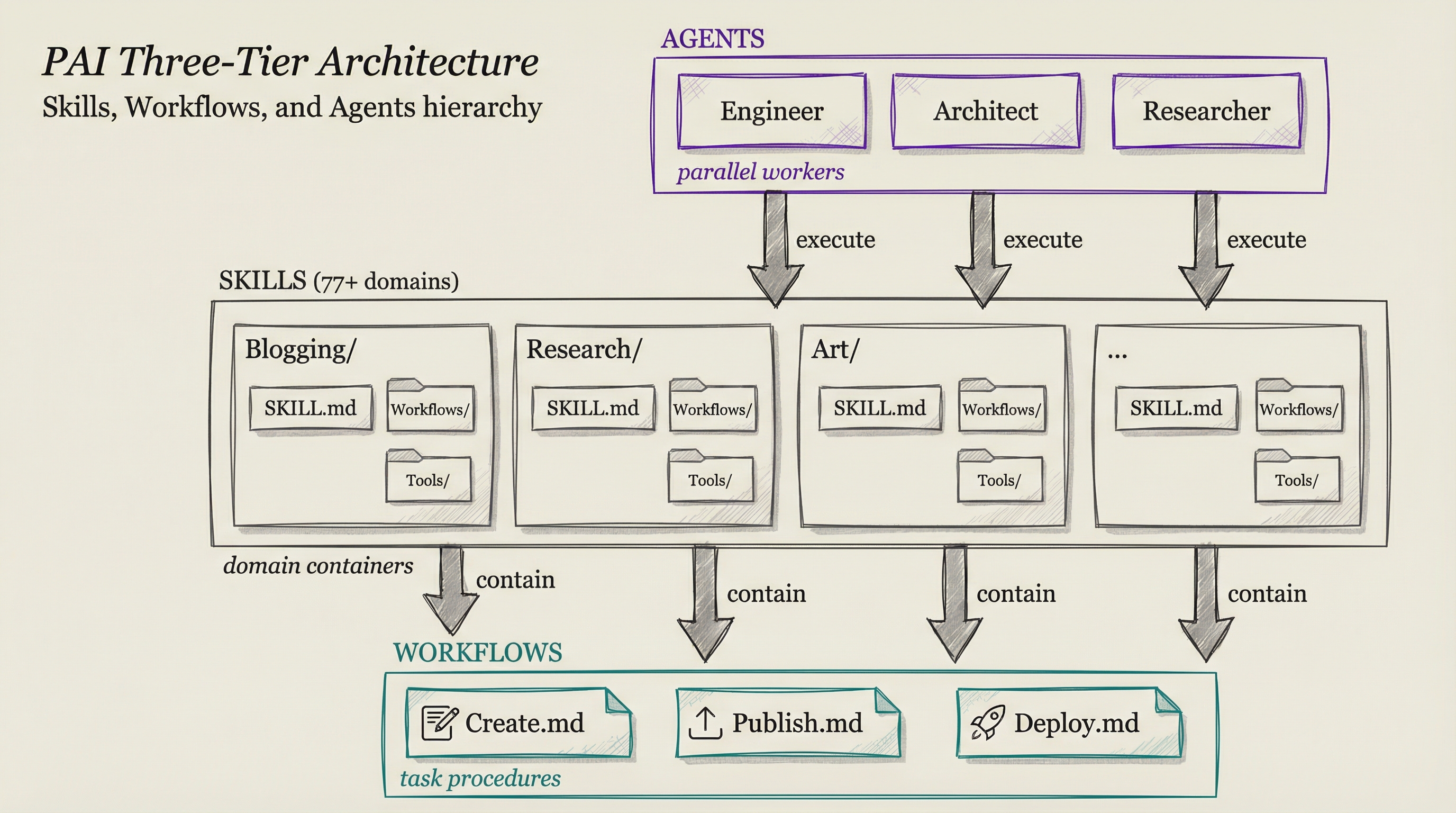
When Anthropic released Skills in October 2025, I faced a confusing problem: Skills, Workflows (formerly Commands), and Agents are all essentially markdown files containing prompts. Structurally identical. So which do you use, and when?
The Quick Answer
| Primitive | Purpose | When to Use | Location |
|---|---|---|---|
| Skill | Domain container | Grouping related capabilities | ~/.claude/skills/{Domain}/ |
| Workflow | Task procedure | Executing specific operations | ~/.claude/skills/{Domain}/Workflows/ |
| Agent | Parallel worker | Concurrent multi-task execution | ~/.claude/agents/ |
The Hierarchy
┌─────────────────────────────────────────────────────────────┐
│                         AGENTS                              │
│            (Parallel workers - execute skills)              │
│  ┌─────────────┐  ┌─────────────┐  ┌─────────────┐         │
│  │  Engineer   │  │  Architect  │  │  Researcher │   ...   │
│  └──────┬──────┘  └──────┬──────┘  └──────┬──────┘         │
└─────────┼────────────────┼────────────────┼─────────────────┘
          │                │                │
          ▼                ▼                ▼
┌─────────────────────────────────────────────────────────────┐
│                         SKILLS                              │
│              (Domain containers - 77+ skills)               │
│  ┌─────────────────────────────────────────────────────┐   │
│  │  Blogging/       Research/        Art/         ...  │   │
│  │  ├── SKILL.md    ├── SKILL.md    ├── SKILL.md       │   │
│  │  ├── Workflows/  ├── Workflows/  ├── Workflows/     │   │
│  │  ├── Tools/      ├── Tools/      ├── Tools/         │   │
│  │  └── *.md        └── *.md        └── *.md           │   │
│  └─────────────────────────────────────────────────────┘   │
└─────────────────────────────────────────────────────────────┘
          │                │                │
          ▼                ▼                ▼
┌─────────────────────────────────────────────────────────────┐
│                       WORKFLOWS                             │
│           (Task procedures inside skills)                   │
│      Create.md   Publish.md   Deploy.md   Research.md       │
└─────────────────────────────────────────────────────────────┘Skills = Domain containers (Blogging, Research, Art, Security) Workflows = Task procedures (Create, Publish, Deploy - nested inside skills) Agents = Parallel workers (Engineer, Architect, Researcher - execute skills concurrently)
Skill Structure
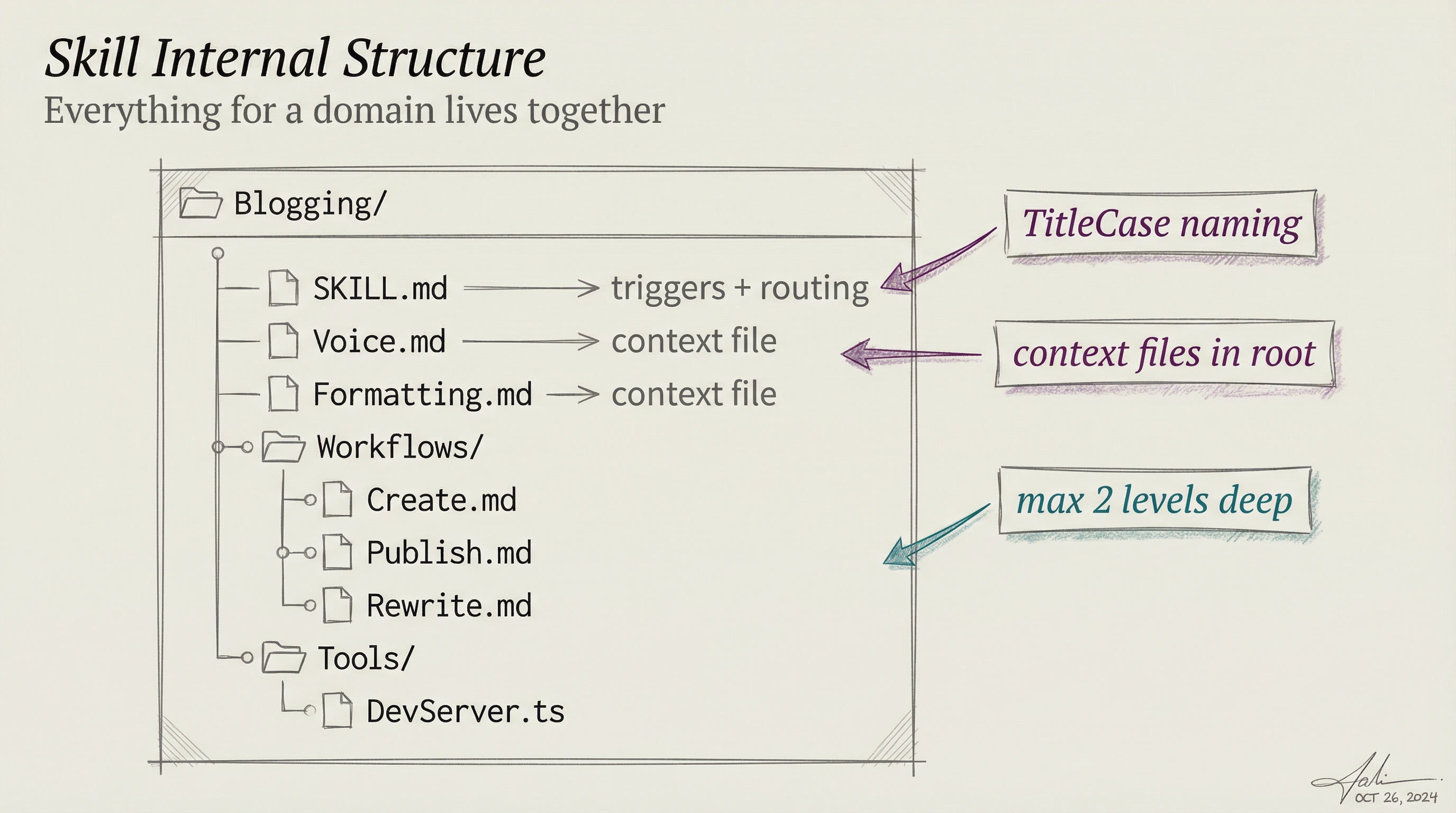
Every skill follows this flat structure:
~/.claude/skills/
├── Blogging/                  # Domain container (TitleCase)
│   ├── SKILL.md               # Main file: triggers, routing, docs
│   ├── Voice.md               # Context file (in root, NOT in subdirectory)
│   ├── Formatting.md          # Context file (in root, NOT in subdirectory)
│   ├── Workflows/             # Task procedures only
│   │   ├── Create.md          # Write new content
│   │   ├── Publish.md         # Deploy to production
│   │   └── Rewrite.md         # Edit existing content
│   └── Tools/                 # CLI automation
│ └── DevServer.ts # TypeScript toolingKey rules:
- TitleCase naming everywhere (
Blogging, notblogging) - Context files in root (no
context/subdirectory) - Workflows/ contains only execution procedures
- Tools/ contains CLI automation scripts
- Maximum 2 levels deep (flat hierarchy)
Skill Anatomy: SKILL.md
The main skill file has two parts:
1. YAML Frontmatter (what triggers activation):
---
name: Blogging
description: Blog workflow. USE WHEN blog, website, publish, deploy, write.
---2. Markdown Body (routing and documentation):
# Blogging

## Workflow Routing

| Workflow | Trigger | File |
|----------|---------|------|
| **Create** | "write a post" | `Workflows/Create.md` |
| **Publish** | "deploy", "publish" | `Workflows/Publish.md` |
| **Rewrite** | "edit this post" | `Workflows/Rewrite.md` |Claude matches your intent to the description, loads the skill, and routes to the appropriate workflow.
The Three Tiers Explained
Tier 1: Skills (Domain Containers)
When to use: Organizing a domain of related capabilities.
Skills are self-contained modules. Everything for blogging lives in skills/Blogging/. Everything for research lives in skills/Research/.
When you say "write a blog post," the Blogging skill activates, analyzes your intent, and routes to Workflows/Create.md.
Tier 2: Workflows (Task Procedures)
When to use: Executing a specific task within a domain.
Workflows are step-by-step procedures that live inside their parent skill. They're the "how to do X" files.
Examples:
Blogging/Workflows/Create.md— How to write a new postResearch/Workflows/ExtensiveResearch.md— How to conduct deep researchArt/Workflows/Essay.md— How to create blog header images
Tier 3: Agents (Parallel Workers)
When to use: Concurrent execution of multiple tasks.
Agents are standalone files in ~/.claude/agents/ that execute work in parallel. They invoke skills and workflows as workers.
Example flow:
- You request complex research
- The Research skill spawns 3 parallel agents
- Each agent executes research workflows on different sources
- Results merge back together
Example: My Current Structure
~/.claude/
├── skills/                    # 77+ domain containers
│   ├── Blogging/
│   │   ├── SKILL.md           # Routing and documentation
│   │   ├── Voice.md           # Writing style guidelines
│   │   ├── Formatting.md      # Post structure rules
│   │   ├── Workflows/
│   │   │   ├── Create.md
│   │   │   ├── Publish.md
│   │   │   └── Rewrite.md
│   │   └── Tools/
│   │       └── DevServer.ts
│   ├── Research/
│   │   ├── SKILL.md
│   │   ├── Sources.md
│   │   ├── Workflows/
│   │   │   ├── QuickResearch.md
│   │   │   ├── StandardResearch.md
│   │   │   └── ExtensiveResearch.md
│   │   └── Tools/
│   ├── Art/
│   │   ├── SKILL.md
│   │   ├── Aesthetic.md
│   │   ├── Workflows/
│   │   │   ├── Essay.md
│   │   │   ├── TechnicalDiagrams.md
│   │   │   └── Mermaid.md
│   │   └── Tools/
│   │       └── Generate.ts
│   └── ... (74 more skills)
├── agents/                    # Parallel workers
│   ├── Engineer.md
│   ├── Architect.md
│   ├── Researcher.md
│   └── ... (20+ agents)
└── MEMORY/                    # Learning and state
    ├── LEARNING/
└── STATE/Key Benefits
Encapsulation: All blogging capabilities live in one place.
Discoverability: ls skills/Blogging/Workflows/ shows all blogging tasks.
Portability: Skills are self-contained and shareable.
Intent routing: Natural language triggers the right skill automatically.
Modularity: Small, focused files instead of monolithic prompts.
Decision Flowchart
When adding new capability, ask:
- Does this belong to an existing domain? → Add to that skill
- Is this a new domain? → Create new skill
- Is this a specific task? → Create workflow inside skill
- Does this need CLI automation? → Create tool inside skill
- Does this need parallel execution? → Create agent
The system is working well—I currently have 77 skills, hundreds of workflows, and 20+ agents, all following this structure.
Notes
- Simon Willison's analysis of Claude Skills from October 2025. Claude Skills are awesome, maybe a bigger deal than MCP
- Daniel's Personal AI Infrastructure project is open source. PAI on GitHub
- Anthropic's official Skills documentation. Agent Skills Documentation
- 🤖 AIL 1: Daniel wrote this post. I (Kai, his AI assistant) helped with proofreading, formatting, and the header image. Learn more about AIL.