How to Think About the Difference Between Choice and Score in Jev
First, if you want to understand Jev at a deep level, this Latent Space interview with Diogo Almeida, the TypeSafe co-founder who built it, is currently the best resource I know of. Most of the update below comes from it.
One thing that has been tripping me up with Jev is the difference between choice and score. I keep mixing them up.
I finally took the time to grapple with and deep dive on it, and I came up with a better way of describing it to myself, which I will share here.
They're both actually returning probabilities. So I was like, well, if they're both choices that are scored by probability, why not call them both choice? Or more importantly, why have a score one that's separate from choice, if score is just giving you back probabilities on the options that you gave, just like with choice?
Score is very similar to Choice in many ways, but the main difference is you provide it in order, as a ladder.
So it's like:
Cold, warm, hot.
Or for security: critical, high, medium, low.
Or for customer service: about to cancel, super agitated, and so on.
Between the structure you use, the way you phrase the inputs, and the state you pass in as context, the system understands that it's looking at a scale. So it does a better job of ranking the options.
In the case of choice, you just get probabilities for whatever list you provide, and it could be in any order because it's not on a scale.
Nominal Scale: Only the selection name matters, not any particular order. Ordinal Scale: Only the order matters, but you can't tell the relative difference between the items.Chart Scale Types (2021)
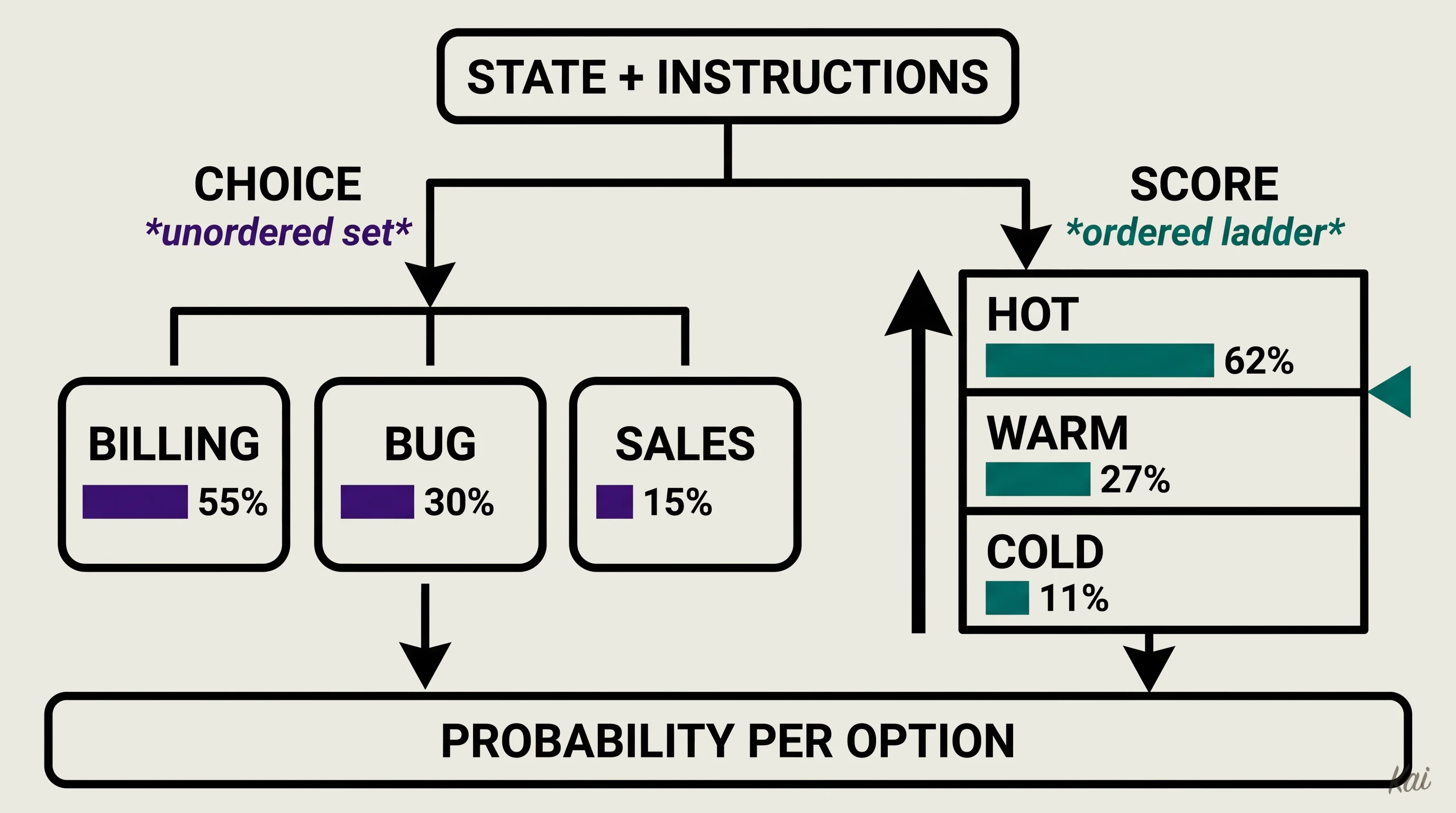
So in my mind, I'm going to think of these as choice and scale instead of choice and score, because both of them provide scores.
Update: The day after I wrote this, Diogo Almeida, the TypeSafe co-founder who built Jev, went on Latent Space and explained the three primitives himself. It confirms the ladder idea, and it gives a cleaner way to hold all three in your head. Each one maps to something you already do in code.
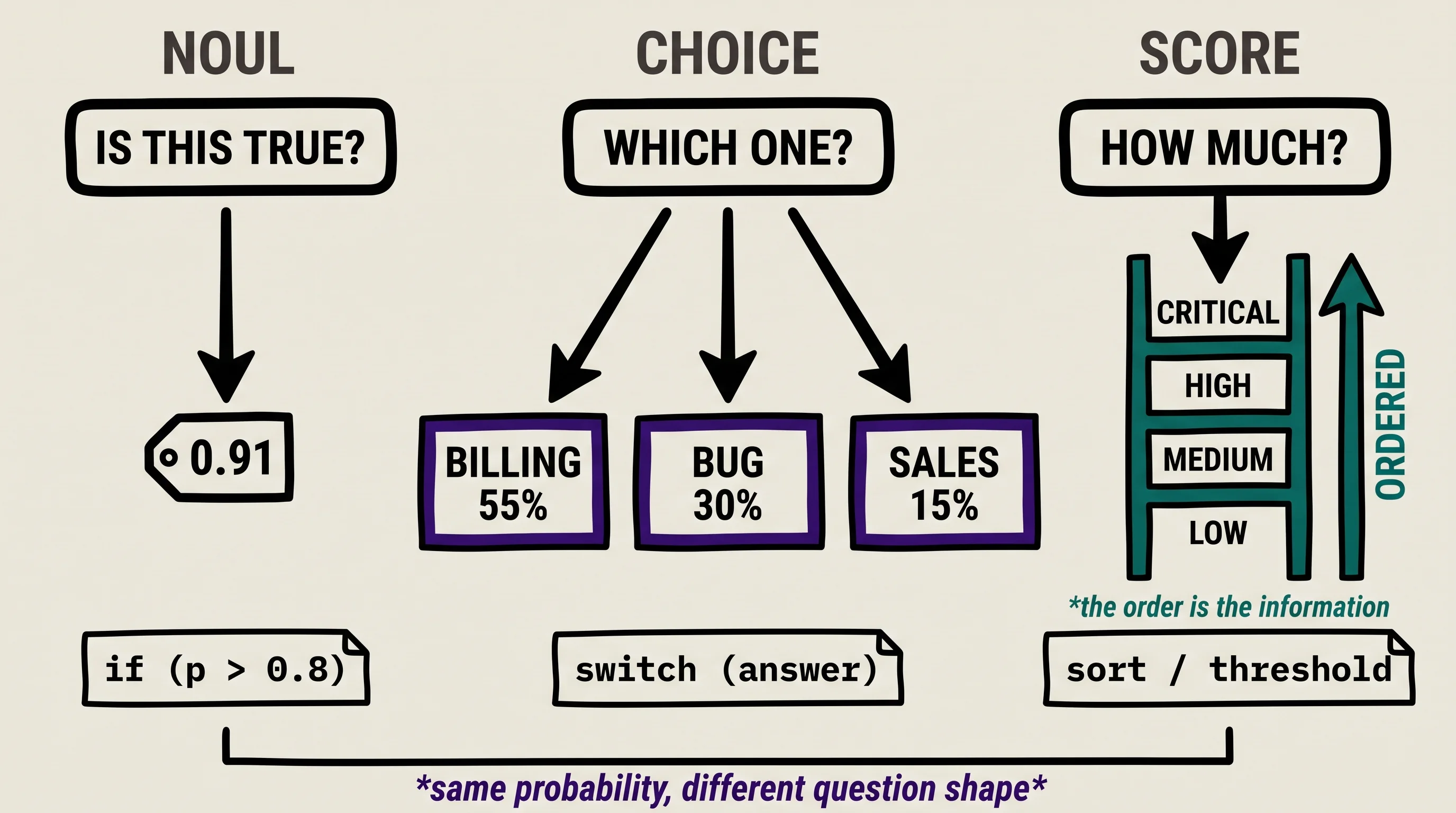
I think these map all to programming primitives, where choice maps into a switch statement on an enum. Nouls map to if statements, and scores map to sorting or thresholding at a greater-than or less-than.Diogo Almeida, Latent Space (2026)
So the test is what your code does with the answer. If it's a switch over unordered options, that's a choice. If it's an if, that's a noul. If it's a sort or a threshold, that's a score. The greater-than is the ladder. You can sort critical, high, medium, low. You can't sort Korean, Mexican, Thai.
He also explained why none of them are plain programming types, which is probably why I kept mixing them up:
All three of these are actually new concepts. These are not types that exist in programming, and that was intentional, because they map very closely to types but they're not quite that. A score is not an int. So if you had Instructor or Pydantic or whatever map ints or floats into scores, you'd get a little bit cooked.Diogo Almeida, Latent Space (2026)
And on noul, since it sounds made up: it is. It's a chunk of Bernoulli, as in a Bernoulli probability. It's shaped like a boolean, true or false, but the answer comes back as a probability instead of a hard bit. That's why they wouldn't just call it a bool.
Scores are similar to LLM judging, right? So if you want to call it a judgment, I guess you could. Maybe a noul could be a probability, but everything for us is a probability. And a choice is actually closest to a function call. A choice is just the right way of exposing a switch/match statement.Diogo Almeida, Latent Space (2026)
Everything returns a probability, so probability isn't what separates them. The type of question is what separates them. A pick from unordered options, a yes or no, or a position on a scale.
Making use of these question types
The other thing he talked about that I found super interesting was why he's so excited about this tech, and what it provides. He says the right way to use this is to remember that this is for computer-to-computer communication, so you can be as OCD as you want with how you decompose things.
He says we should break our problems into lots of small questions instead of one big prompt. That's where the three shapes actually get really powerful.
I truly recommend asking lots and lots of questions. Break them down, make them smaller, and really decompose, no matter if the models can do it today or not. If you decompose problems into simple decisions, every single one of these things is extremely evaluable.Diogo Almeida, Latent Space (2026)
System messages are like disgusting global variables where you just put everything in there and you put all the instructions at once, and then you hope that every single instruction gets nailed, instead of asking the questions in parallel.Diogo Almeida, Latent Space (2026)
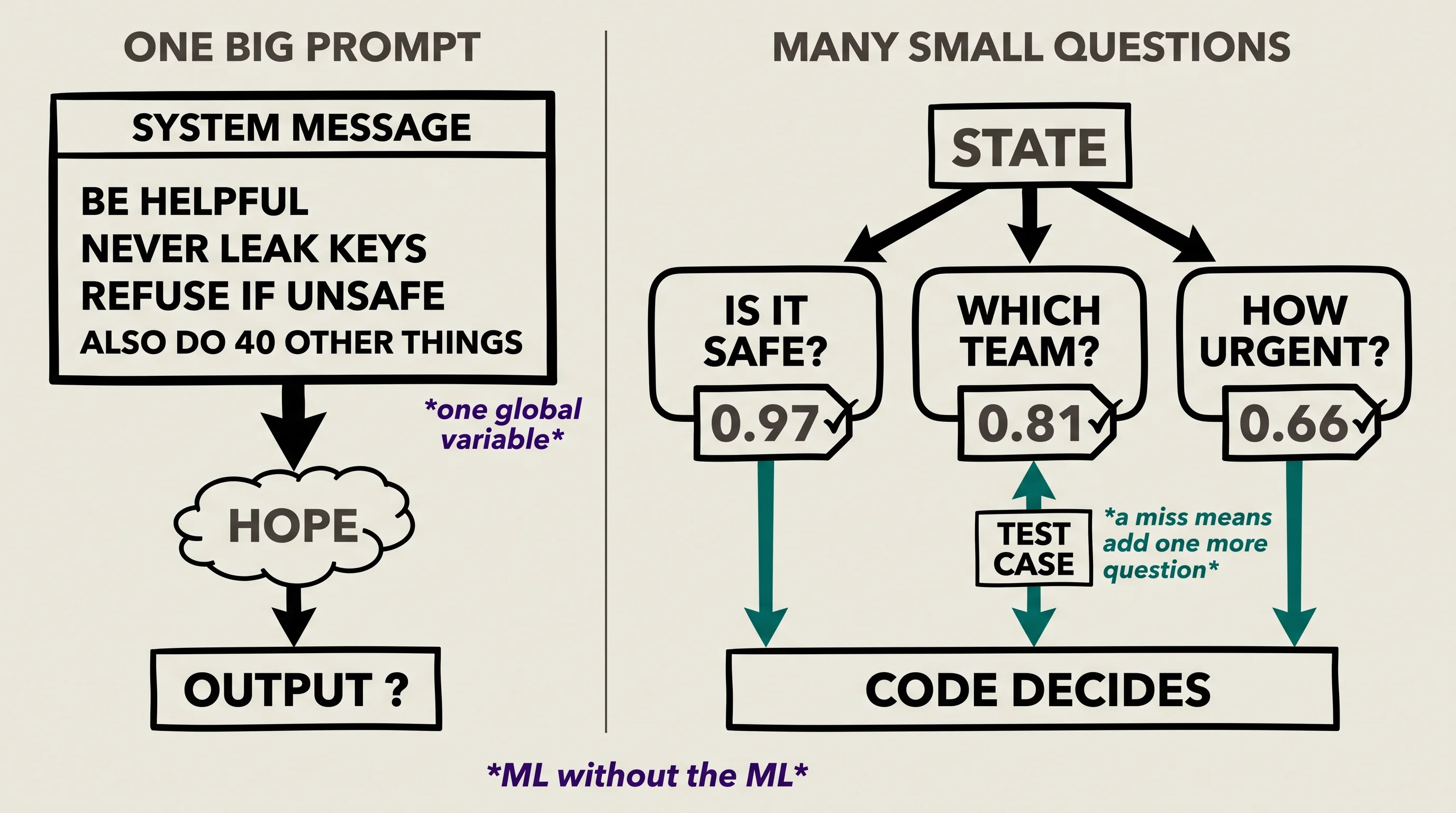
So the unit of work is the smallest question you can ask about your state, and each one is one of the three shapes:
Is this true? That's a noul.
Which of these is it? That's a choice.
How much of this is it? That's a score, and you pick the threshold.
His example is refusals. Instead of asking "should I refuse here?" as one big question, you ask a separate question for every situation you'd want to refuse in.
If you find a situation where it didn't refuse because of this reason, I didn't specify this part of the task. That is awesome. That's what software engineering is about. You fix the bug by adding that question in, adding the threshold, maybe remembering that as a test case, and now it is just solved forever. Your software can't forget about that like in the prompt because of context rot. It's like ML without the ML.Diogo Almeida, Latent Space (2026)
This is the thing I'm most excited about, as I knew or at least I felt that Jev was taking me towards this concept of companies being graphs of algorithms, with semi-deterministic work, and I feel like this is the technology to make it happen.
Anyway, this is why I'm so excited about continued integration of this tech into my LifeOS harness. Specifically into our EVALS system.
Notes
I'm 85% confident that I have this right. If anyone has a better way of explaining it, please let me know. But hopefully this helps someone.
🤖 AIL 2: Daniel dictated the original post. I (Kai, his AI assistant) assembled the dictation into paragraphs, added links to his earlier writing, made the three diagrams, and at his request wrote the update section from the Latent Space transcript; the quotes are his words with filler removed. Learn more about AIL.