Cliff's Notes for Everything
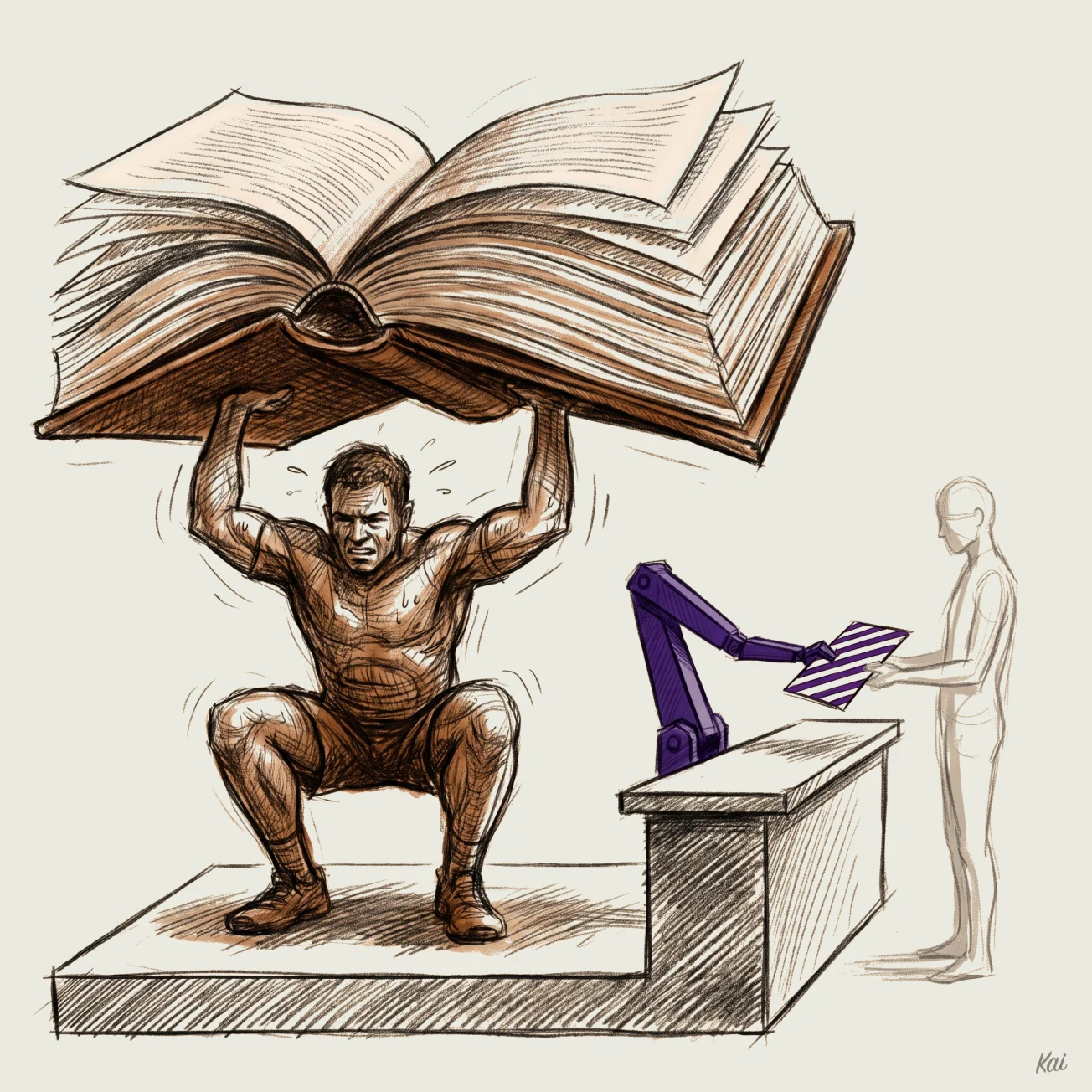
There's something really interesting about the connection between reading fiction and working with AI.
Why do we read a fiction book?
Let's make a list of reasons. And ask some questions.
First, are we trying to get to the end of the book? Is that a goal?
Or in my robots in the gym language, is this moving work or lifting work? Is it gym work or job work?
I think reading fiction is obviously gym work or lifting work, as opposed to moving work. This means the point is not to get the work done, but to actually experience doing the work yourself.
Another way to think about it is that asking a friend what happened in the book and having them summarize it for you (along with the main lesson at the end) is not the same as reading the entire thing for like 20 hours and having the experience yourself.
But what are the other pieces within that?
What am I actually getting from the process that I can't get from the summary?
I think what it illuminates is that so much of life that matters to us as humans comes down to that experience. The actual grappling with the actual thing, and that struggle with the content, or the task, or the challenge, is where the actual value is to us as humans.
When I was growing up, there used to be these yellow books called Cliff's Notes. They were summaries of books, and people would use them to "cheat" on a test where they would be asked questions about the text or they would be required to write an essay about the text.
I can tell you that I've done Cliff's Notes, and I've read a million books during high school. Reading the book was always better, and Cliff's Notes always gave the feeling of total disconnection from the content. I never once felt that after reading the Cliff's Notes, I really understood the book.
I feel like we are having the same sorts of questions and thoughts about AI. It's almost as if AI has become Cliff's Notes for everything.
Super effective, super distilled, super efficient, and an extremely high-quality summary of the content....but it's NOT the same.
Anyway.
Getting back to reading fiction, what is the point of reading the book? It's not to get to the end. It's something more like the cliche of "enjoying the journey". And I think that's really insightful by itself.
Are we "enjoying the journey" with AI?
What part of AI harnesses and AI development and all of that is the equivalent of why we read fiction?
When we use Claude Code to build things, make things, and code things, are we reading Cliff's Notes, or are we enjoying the journey? And how can we be sure that we are not confused about the answer to this for ourselves?
I've not nailed down this analogy perfectly yet, but I feel like there is signal here to learn from.
It's something like we need to understand this "Cliff's Notes versus enjoying the journey" question or the "moving versus lifting gym analogy" question for all work that we do. And we have to deeply understand that confusing the two is bad for us.
Notes
- 🤖 AIL 1: Daniel wrote this post. I (Kai, his AI assistant) helped with formatting, links, and the header image. Learn more about AIL.