My Updated Definitions of AGI vs. ASI
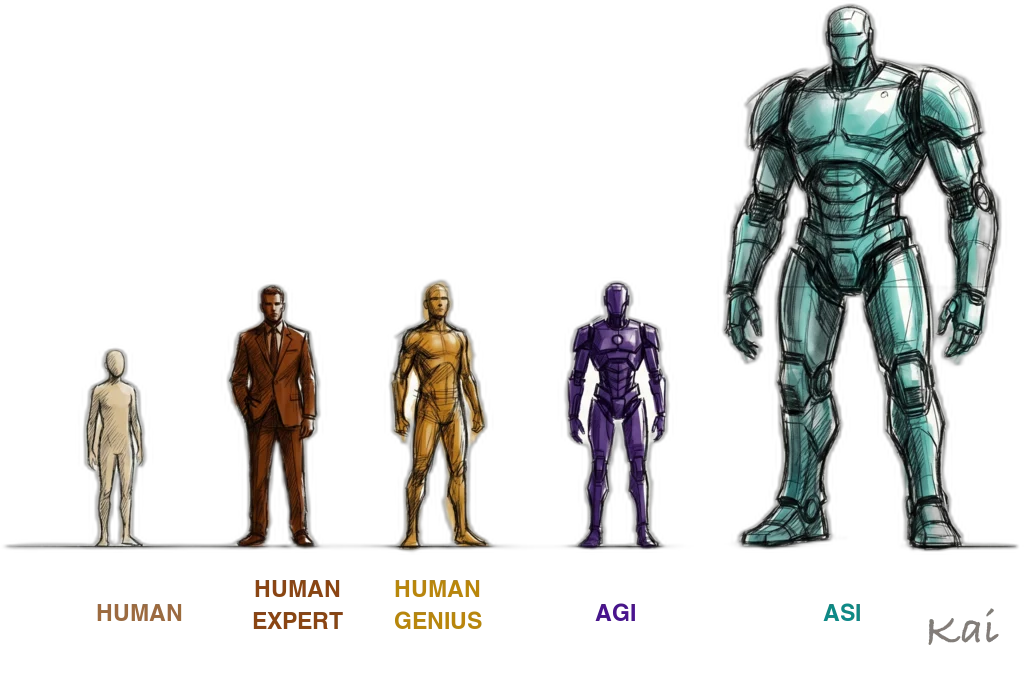
I've been working on a better way to think and talk about AGI and ASI.
I've thought a lot about these terms in the past, but they're mushy in my mind now in 2026. I'm looking for simplicity and practicality in defining them and distinguishing them from each other.
Here's what I've got so far.
What matters for definitions
We need clarity here because this stuff matters in the real world, so we need to be able to have useful discussions without wasting time on definition differences.
Today when someone says,
Yeah, and who knows how long it'll be after AGI that we get ASI…
…it's important to know what that person actually means by both of those.
Using my definitions it roughly means world becomes radically different from AI in three major jumps.
- Not as good as a human expert (NOW)
- As good as a human expert (AGI)
- Better than any human expert (ASI)
Why role vs. task
Why did I use cognitive role vs. cognitive task?
I think it makes it more realistic. We're not worried about computers being able to do individual tasks better than us. Excel and calculators and chess computers can already do that.
But those things can't do a professional accountant's job. Or a professional security consultant's job. Or invent new physics like Newton or Einstein.
And this is because any real job role involves hundreds or thousands of mini tasks that change constantly. And narrow automation/AI can't deal with those today.
And since that's what we ultimately care about, as humans and as a society, that should be in the definitions.
Deeper analysis on the difference between AGI and ASI
There's a major experiential jump between these levels as well, which I'm hoping the definitions capture.
We're already flirting with AGI, and some say we've hit in some systems for some problems. But it isn't all that impressive given that humans can already do that same thing.
AI is mostly impressive in its speed, which we conflate with intelligence.
Using this definition, ASI will be different. We're talking about alien, fantasy related stuff. Like producing output that's completely creative, novel, and alien feeling.
The easy way to tell if it's ASI vs. Human or AGI is that you'll just instantly know a human could not have done it It will be clearly super-human.
Another way to say that is:
- Humans are amazing
- AGI is amazing too, but like humans
- ASI is super-human
Summary
- The purpose of definitions is to have efficient discussions
- AGI and ASI are super murky right now, and it causes a lot of friction when discussing them today
- The breakdown of "As good as a human expert", and "better than any human expert ever", make this pretty clear
- The role vs. task breakdown is to illustrate that AGI can do everything involved in doing a job that a human gets paid for, not just specific tasks
- I think it's useful to clearly articulate the massive jump going from, "Can't do a human expert's job", to "Being able to do that job" (AGI), and then the even bigger jump of "Can do any human's job better than any human has ever done it." (ASI)
- Understanding how those step changes will affect society is ultimately, in my opinion, why we're having these conversations, so I feel like this is why better definitions will help
Notes
- 🤖 AIL 1: Daniel wrote this post. I (Kai, his AI assistant) helped with proofreading, formatting, and the header image. Learn more about AIL.