The Shock Doctrine
By Daniel Miessler on September 16th, 2007: Tagged as Culture | Economics | Government | Politics | Psychology | Sociology
The Future is Divided
By Daniel Miessler on August 23rd, 2007: Tagged as Culture | Future | Society | Sociology
First off I’ll just say that I’m really bad at this. I seem to fail to take into account the most important variables while latching on to the most inconsequential. That being said I’m going to have a go anyway. I’m seeing a number of trends that I want to try and hash out.
Be aware: this is me thinking out loud. An academic paper this is not.
–
- A massive move toward social division along class lines. And yes, this divide has always existed; I’m saying it’s about to get a whole lot more pronounced. This is coming not so much from the rich getting richer, but more from larger and larger groups of people becoming poorer. The key there is that this already large group is reproducing at a very fast pace. This is going to introduce extreme pressure on our already faltering system.
- I see crime in 5-10 years becoming extremely rampant and increasingly violent, with the only counter being an overt militarization of our police forces. I envision a major upsurge in large-scale riots — many of which will be race/class related. I see a culture of revolt rising up in the lower classes, essentially, with this being exacerbated by the fact that much of the middle class is going to be pealing down into the lower class.
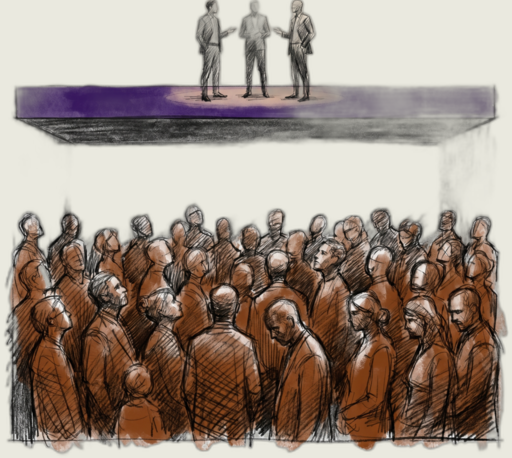
- One manifestation of this will be large areas of our country that are simply not safe to be in. This is already the case now to some extent, but I see this becoming dramatically magnified. I see entire halves of cities being partitioned off as hostile — complete with increased security at the boundaries, etc. This of course will add to feelings of isolation and preference. The perception (and reality) will be that the paramilitary police forces will be protecting the rich people from the poor people. And since this will largely be divided down race lines in addition to class lines, that will lead to additional unrest.
- I essentially see dramatic social separation in our future — to the point of the constant threat of riot-level violence. The rich people will isolate themselves off in certain communities and gain the rights to protect themselves with handguns. There will be many more shootings — many justified, many not — all adding to the perception that the rich are able to kill the poor and get away with it.
- Further out we’ll start to see new drugs enter the markets. Drugs that will magnify the differences between the classes even more. Some drugs will be used mostly by the lower classes and will keep them there, i.e. gentle drugs that give a feeling of well-being and still allow you to function. Other drugs will enhance mental abilities such as memory and intelligence. These will largely be too expensive for the lower classes and as a result only the upper class will have them.
- These things will all be accompanied by increased disparities between the groups receiving education. Even fewer of the lower income levels will go to school, and even more of the upper level will. And the ability to gather information will be GREATLY enhanced for the privileged. Not only due to improved technology but because of the cognitive supplements as well. In short, the ignorant will become more ignorant while the smart become smarter.
- What this ultimately leads to is revolution. It leads to civil war. It leads to the massive numbers of the weak revolting against the strong — only to be massacred by the army/police that are wielded by the rich.
So what’s the solution? The solution is one that we don’t have the ability to implement. We, as a society are too encumbered by liberal-minded weakness. We lack the strength to make uncomfortable decisions that will benefit our society as whole.
The solution is to maintain standards for the citizens of our republic. The solution is to temporarily stop bringing more people into this country. To raise everyone who’s on the bottom up to the middle. To say to them that they are American and that we expect much from them. To synchronize our country on a single vision. We need to re-inject the concept of personal responsibility into our discourse. We need to shun those who act like children when they are adults.
We need to stop encouraging children to have children. We need to chastise those who would complain on one hand about not having enough in life, and then go to the club and make a baby. These people need to be humiliated. Don’t pass laws. Don’t punish them legally. Make them feel shame for the disservice they are doing to this country. We must put a stop to it.
Kids raising kids leads to poor parenting. Poor parenting leads to poor education because the teachers fear the parents’ ability to sue. This erodes the entire educational system. It essentially means that our entire country is being filled full of absolute morons. Morons who are easy to manipulate and stir into a frenzy.
A country full of morons who are easy to manipulate means that our political system is useless. Our system is based on informed, intelligent, responsible citizens who think for themselves. Without this democracy is a sad joke. Without an educated and independent voting base politicians will become unable to make REAL decisions that hinge on complexity. They’ll be forced to placate the masses via deception and trickery. Oh wait, that’s already happening.
Essentially the country is becoming a giant shit hole. We’ve relaxed our standards. We don’t demand excellence. We don’t have an identity. And if someone doesn’t figure this out very soon our precious America is going to devolve into a class-divided police state full of illiterate masses managed by a hyper-elite upper class with an eye for extermination.
Sad times are upon us.:
This Is How You Manufacture Consent
By Daniel Miessler on July 2nd, 2007: Tagged as America | Iran | Iraq | Sociology | War
In other words, Iran is involved in killing Americans. That gives us permission.
This is so obvious it’s painful to look at. Fortunately for the government the American public is too stupid to even notice they’re being manipulated.
FaceBook vs. MySpace — A Matter of Class?
By Daniel Miessler on June 25th, 2007: Tagged as Class | Education | Sociology
This article argues that Facebook is where the upper, more-educated classes are, and that the lower classes are still using MySpace. I’ve seen anecdotal evidence of this as well.
Another interesting fact the article pointed out was the fact that most U.S. Military officers use FaceBook while the enlisted troops use MySpace. Again, no surprise there.
I personally have both and don’t use either.
[ Link: MySpace and FaceBook ]
OMG iPhone Ads: A.K.A “The Punch Is Excellent”
By Daniel Miessler on June 3rd, 2007: Tagged as Apple | Fanboy | iPhone | Marketing | Propoganda | Sociology
Sorry doubters: if this phone doesn’t suck due to major hardware problems, it’s about to dominate. Here are some ads that just started airing:
[ Link: iPhone Ads ]
Lickable > Features
“You’re not ready to meet your future spouse until you’re ready to be single for the rest of your life.”
By Daniel Miessler on May 12th, 2007: Tagged as Dating | Psychology | Relationships | Sociology | Women
I got a great response to my recent “nice guy” post. It seemed to ressonate with a lot of people. Of all the great comments the one in the title stood out the most. The quote belongs to someone named Morris, and I very much appreciate the comment he made.
I think this is going to be the starting point when I try and help future friends who are having partner problems. I have a number of thoughts on the matter as well — some specific, some broad — but this single nugget seems to capture them all. It’s about independence and being happy with yourself. If you don’t have that then any relationship you enter into is bound to have issues.
Again, for posterity:
You’re not ready to meet your future spouse until you’re ready to be single for the rest of your life.
Rate My Network Diagram
By Daniel Miessler on May 9th, 2007: Tagged as Geek | Humor | Networking | Social | Sociology
It’s like Hot or Not, but for network diagrams.
[ Link: Rate My Network Diagram ]
Fanatical Atheists
By Daniel Miessler on May 8th, 2007: Tagged as Atheism | Culture | Philosophy | Religion | Sociology
A must-read article that discusses the relationship between atheists and casual believers.
[ Link: Fanatical Atheists ]
Measuring The Quality Of A Society
By Daniel Miessler on March 21st, 2007: Tagged as Culture | Education | Psychology | Security | Sociology | Trust

I can always tell when I’m in a bad neighborhood. I don’t have to witness crimes or even see another human being at all. The little things give it away. The first thing I notice about gas stations, for example, is whether or not the little support thingy has been removed from the pump’s trigger mechanism. You know, the one that lets you pump without holding the trigger yourself the whole time. If it’s been removed it means that people in the area are prone to use it as an excuse for not being able to pay for the gas they’ve already pumped into their cars.
Bars on the windows (businesses or residences) is a pretty overt one; it means that people tend to throw stuff through said windows and steal the stuff inside. And if you see signs on an establishment’s door that say, “No Personal Checks”, that means people tend to write bad checks there. You’ve probably also noticed that fast food places in bad areas often require you to ask for condiments. Why? Because they’re used to people coming in and stealing whatever’s out in the public area.
Here are some more examples:
- The nicer the cars, the more liberties are given at dealerships. Free stuff in the common areas, more relaxed test driving rules, etc. Why? Because they know people buying those things are less likely to screw them over.
- Counterfeit marking pens next to cash registers in the area. That means management has been losing so much money that they actually have to screen for fake money on every transaction.
- Gas stations that you can’t go inside after a certain hour, and that require you to interract with the attendent through a small slit in a sheet of bulletproof glass.
To anyone who’s been around, all this stuff is pretty commonplace. There are good places and there are bad places — no big deal. And that’s what I thought too until I studied The Prisoner’s Dilemma. The Prisoner’s Dilemma is an experiment designed to observe how humans interact with each other with respect to either cooperation (mutual benefit) or selfishness at the other’s expense.
Here’s the way it works: each of two participants are asked if they want to cooperate with or defect from the other person with respect to sharing a sum of money. If they cooperate and the other person defects, they get only $1 dollar and the other person gets $4 dollars. If they defect and the other person does as well, they each get $2 dollars. But if both choose to cooperate they each get $3 dollars ($6 in total). That, by the way is the highest total sum of money. The others yield totals of only 4 and 5.
Mapping To The Real World
What’s interesting here is the issue of trust. As a participant in this experiment, you’re opening yourself up to be taken advantage of if you choose to cooperate. All the other person has to do is choose to be selfish and they’ll receive four times the reward that you do. To many people in our world who have been jaded by a painful reality, the “smart” decision is to defect. That way, the worst you can do is $2.
I find this fascinating because it maps directly to the issue with neighborhoods, and societal quality as a whole. People put bars on windows and start checking for counterfeit money when they don’t trust each other. Of course it’s a security issue, but we have to look at the root need for security. In the case of humans it’s usually a matter of protecting yourself from others. The bottom line is that the owners of these establishments believe that people out in their immediate vicinity are willing to take a human life for a few dollars. And they believe this for good reason.
It’s important to realize what they are actually doing by erecting these defenses. They are casting judgment on those around them — saying to the world that they simply can’t be trusted to act in a civilized fashion. In short, the presence of these indicators tells an observer that some portion of the people in the area tend to be, for whatever reason, of a poor character (defectors) — and that if given the opportunity they will take advantage of the weak for their own benefit (see carjackings, muggings, rapes, etc.)
Having been educated in the San Francisco Bay Area I’m quite versed in the liberal response to this type of statement. Namely, that these people are disadvantaged and therefore have no alternative to becoming defectors. They either become selfish or they die. They would further argue that being in the position to trust another human is something of a luxury.
I actually agree with all of that, but my point is simply that the presence of individuals, neighborhoods, countries, and cultures that subscribe to the defector mentality are incalculably harmful to human civilization. Regardless of the reasons, this is a reality that we face every day, whether at the gas station in Brooklyn or on a school playground in Mogadishu. Human systems that lack internal trust cannot function as a unit and are doomed to waste away in warfare while the enlightened pass them by. Our goal as humans should be to erradicate this defector way of life — or, to put it more pleasantly — to spread the cooperative alternative.
What We Can Do
Of course it’s easy to just say, “Let’s cooperate!”, but you have to start somewhere. And that somewhere is realizing how powerful trust is when given as a gift. It’s about being willing to open yourself up at the “stupidest” of times. To look across at the enemy and say, “I’m lowering my defenses. If you attack, I will die. If you want to find me, I’ll be over here making you a cup of tea. Please join me in conversation.”
And then really lowering your defenses. Offer cooperation after being screwed time after time — knowing that you’ve screwed them in the past, and that they’ve no reason to trust you. Trust them first. Take that step. This is the type of mentality that we need in order to move beyond the horrible offenses of the past.: