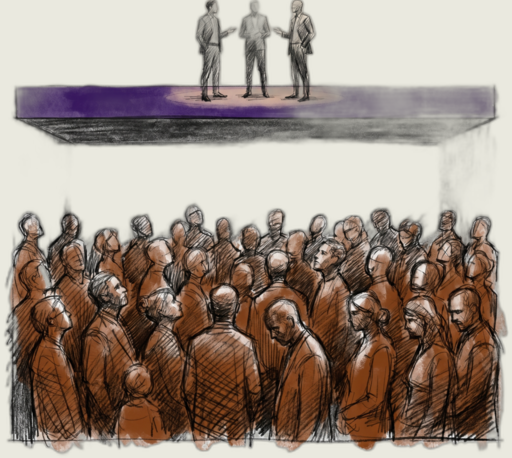
Since gullible people tend to believe what they are told, other folks are more tempted to lie to them. So if one chooses to be gullible, one must accept a lot of responsibility for the lies one hears. Case in point: voters are greatly responsible for the lies their leaders tell them.
Yes. This is why our democracy is doomed.
It takes two, though: The person stupid enough to believe garbage, and the person spewing the garbage knowing they’re stupid enough to consume it. See housing crisis.
The ‘06 documentary The Great Happiness Space (reviewed here) offers an interesting contrast. It shows the world of a certain kind of male prostitute in Japan. And it vaguely implies that male prostitutes exploit their female customers. The message seems to be “Don’t they see how much money they lose for just an illusion of intimacy, respect, etc.?” Even though many of the female customers shown are themselves prostitutes, we are expected to see them as victims.
Of course the two prostitution practices differ somewhat, according to male vs. female fantasies. Men tend more to seek simple no-strings sex and polygamy, while women more seek emotional stroking and hypergamy. But it is striking that any for-pay male-female relation portrays men as exploiters and women as victims, no matter who pays whom.
Stunning. The woman is the victim regardless of whether she’s paying for it or receiving the payment.
There are some jobs where appearance is a bona fide occupational qualification (BFOQ– see, there’s even an acronym for it) and if you have to ask if your job is one of those, it doesn’t. Elite Modeling can hire based on looks, but Abercrombie & Fitch can’t. I leaave you to tease out the details.Surprisingly, ugly people are not a protected class, and phew. But while Pfizer can hire attractive women, it cannot be a hiring strategy. Could a manager choose the prettiest out of all the candidates and get away with it? Sure. But he couldn’t hold out for only attractive ones. So if they did want their salesforce to be all attractive females, it would have to be, in effect, a conspiracy: everyone knowing the deal, and everyone playing along. Do you know how hard it is to get a conspiracy going in this country? It’s impossible.
This guy’s writing is quite refreshing. It’s the writing of someone who doesn’t care, which I wish I had more of at the moment.
For example, obesity chances increase 57% if you have a friend who is or becomes obese. And, more disturbing than that, this is an effect that is conducted through more than one node in the social graph. If your friends’ friends’ friends are obese, you are 10% more likely to be obese
If behavior spreads through social networks, then working in a toxic or slow-moving corporate environment is really really bad for you. If you’re a consultant, you MUST fire the clients that bring you down a notch and seek out clients that pull you up. If you’re a teacher, go where the students care about what they’re learning.
Yup.
Most companies have it all wrong. They don’t have to motivate their employees. They have to stop demotivating them.
People rate statements that have been repeated just once as more valid or true than things they’ve heard for the first time. They even rate statements as truer when the person saying them has been repeatedly lying (Begg et al., 1992).
And when we think something is more true, we also tend to be more persuaded by it. Several studies have shown that people are more swayed when they hear statements of opinion and persuasive messages more than once.
Easy to understand = true
This is what psychologists call the illusion of truth effect and it arises at least partly because familiarity breeds liking. As we are exposed to a message again and again, it becomes more familiar. Because of the way our minds work, what is familiar is also true. Familiar things require less effort to process and that feeling of ease unconsciously signals truth (this is called cognitive fluency).
This is a very accurate article.
Now eLoyalty, a company that builds tools and services for call centers, has created a system that compiles personality profiles of each individual caller and matches them with a customer service representative who works best with that personality type. The system is based on a methodology NASA used to weed out astronaut candidates and that Bill Clinton used to tailor his speeches. It’s already having a marked impact on reducing call frustration and improving customer satisfaction rates.
The methodology, called the Process Communication Model, was created in the 1970s by a clinical psychologist named Taibi Kahler. He divided people into six main personality types, each of which has a different communication style and each of which has different stress triggers. If you know the personality type of the person you’re speaking with, Kahler explained, you can modify your own communication style to work more effectively with them, prevent misunderstandings, and avoid inadvertently pushing the other person’s buttons.
For example, a “Workaholic” personality type is all about the facts. When they call support, they want to focus on the task at hand and blaze through the call as quickly as possible. For them, small talk is nothing but a time suck. A customer service rep who starts chitchatting in a well-meaning effort to establish rapport will only put the caller in a foul mood, which will poison the rest of the interaction. “Reactors,” on the other hand, are all about relationships. A customer service rep who doesn’t acknowledge their feelings will make them feel cold and shut off.
So people think it’s on the rise even though it’s on the decline. My question is why is it on the decline? I have a cynical answer: The would-be offenders are more occupied than they ever have been with television and video games.

New Years resolutions are supposedly for people who plan on making changes in their lives. But they really aren’t. They’re actually for people who only talk about making changes and never do. People who actually make changes, like losing 20 lbs., or getting back into a favorite hobby, just wake up one day and decide to do it. And then they do.
People with the actual self-discipline to plan and implement change in their lives don’t wait for arbitrary time markers to do so. Those that do are pretenders, and that’s why the vast majority of New Year resolutions are never pursued for more than a month or so.
Quite simply, if a person had the fortitude to go further than a few weeks into a resolution, he would have already implemented the desired change. But he doesn’t. So he won’t. ::
tcpdump Tutoriallsof Introductiongit Primerfind Command lsof Commandtar Referencelsof TutorialDaniel Miessler | 1999-2012 | Share Alike
Powered by Linode