The Illusion of Asymmetric Insight | You Are Not So Smart
By Daniel Miessler on January 8th, 2012: Tagged as Politics | Psychology
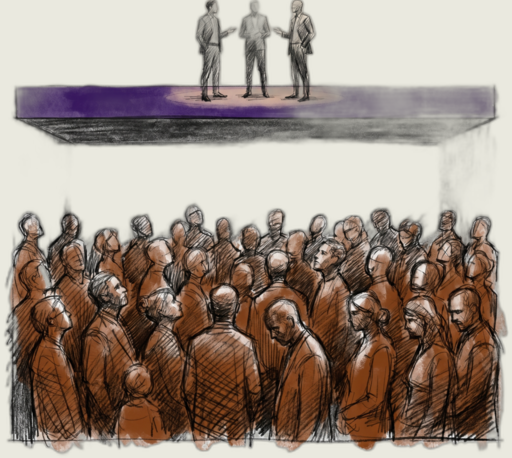
In a political debate you feel like the other side just doesn’t get your point of view, and if they could only see things with your clarity, they would understand and fall naturally in line with what you believe. They must not understand, because if they did they wouldn’t think the things they think. By contrast, you believe you totally get their point of view and you reject it. You see it in all its detail and understand it for what it is – stupid. You don’t need to hear them elaborate. So, each side believes they understand the other side better than the other side understands both their opponents and themselves.
The research suggests you and rest of humanity will continue to churn into groups, banding and disbanding, and the beautiful collective species-wide macromonoculture imagined by the most Utopian of dreams might just be impossible unless alien warships lay siege to our cities. In Sherif’s study, he was able to somewhat reintegrate the boys of the Robber’s Cave experiment by telling them the water supply had been sabotaged by vandals. The two groups were able to come together and repair it as one. Later he staged a problem with one of the camp trucks and was able to get the boys to work together to pull it with a rope until it started. They never fully joined into one group, but the hostilities eased enough for both groups to ride the same bus together back home. It seems peace is possible when we face shared problems, but for now we need to be in our tribes. It just feels right.
So, you pick a team, and like the boys at Robber’s Cave, you spend a lot of time a lot of time talking about how dumb and uncouth the other side is. You too can become preoccupied with defining the essence of your enemies. You too need the other side to be inferior, so you define them as such. You start to believe your persona is actually your identity, and the identity of your enemy is actually their persona. You see yourself in a game of self-deluded poker and assume you are impossible to read while everyone else has obvious tells.
The truth is, you are succumbing to the illusion of asymmetric insight, and as part of a flatter, more-connected, always-on world, you will be tasked with seeing through this illusion more and more often as you are presented with more opportunities than ever to confront and define those who you feel are not in your tribe. Your ancestors rarely made any contact with people of opposing views with anything other than the end of a weapon, so your natural instinct is to assume anyone not in your group is wrong just because they are not in your group. Remember, you are not so smart, and what seems like an insight is often an illusion.
Thinking, Fast, and Slow: Daniel Kahneman | @Google Presents
By Daniel Miessler on January 2nd, 2012: Tagged as Psychology | Science
I just bought four books during the course of watching this talk. Phenomenal.
‘You Are Not So Smart’: Why We Can’t Tell Good Wine From Bad | Atlantic
By Daniel Miessler on October 30th, 2011: Tagged as Apple | Psychology
In one experiment, he got 54 oenology (the study of wine tasting and wine making) undergraduates together and had them taste one glass of red wine and one glass of white wine. He had them describe each wine in as much detail as their expertise would allow. What he didn’t tell them was both were the same wine. He just dyed the white one red. In the other experiment, he asked the experts to rate two different bottles of red wine. One was very expensive, the other was cheap. Again, he tricked them. This time he had put the cheap wine in both bottles. So what were the results?
The tasters in the first experiment, the one with the dyed wine, described the sorts of berries and grapes and tannins they could detect in the red wine just as if it really was red. Every single one, all 54, could not tell it was white. In the second experiment, the one with the switched labels, the subjects went on and on about the cheap wine in the expensive bottle. They called it complex and rounded. They called the same wine in the cheap bottle weak and flat.
Another experiment at Cal-Tech pitted five bottles of wine against each other. They ranged in price from $5 to $90. Similarly, the experimenters put cheap wine in the expensive bottles — but this time they put the tasters in a brain scanner. While tasting the wine, the same parts of the brain would light up in the machine every time, but with the wine the tasters thought was expensive, one particular region of the brain became more active. Another study had tasters rate cheese eaten with two different wines. One they were told was from California, the other from North Dakota. The same wine was in both bottles. The tasters rated the cheese they ate with the California wine as being better quality, and they ate more of it.
In other news, I really like the iPhone 4S.
Study: Power without status can lead to to rudeness, even abuse | CNN.com
By Daniel Miessler on September 24th, 2011: Tagged as Psychology
In an article to be published in the Journal of Experimental Social Psychology, researchers studied the relationship between the status and the power of a job, said Nathanael Fast, assistant professor of management and organization at the University of Southern California’s Marshall School of Business.
The study, “The Destructive Nature of Power without Status,” determined that the combination of some authority and little perceived status can be toxic.
“We found that people who had high power and high status, they were pretty cool,” Fast told CNN. “But it was people who had power and lacked status who used their power to require other persons to engage in demeaning behavior.”
Seems intuitive.
Willpower — By Roy F. Baumeister and John Tierney – NYTimes.com
By Daniel Miessler on September 20th, 2011: Tagged as Psychology
In experiments first reported in 1998, Baumeister and his collaborators discovered that the will, like a muscle, can be fatigued. Immediately after students engage in a task that requires them to control their impulses — resisting cookies while hungry, tracking a boring display while ignoring a comedy video, writing down their thoughts without thinking about a polar bear or suppressing their emotions while watching the scene in “Terms of Endearment” in which a dying Debra Winger says goodbye to her children — they show lapses in a subsequent task that also requires an exercise of willpower, like solving difficult puzzles, squeezing a handgrip, stifling sexual or violent thoughts and keeping their payment for participating in the study rather than immediately blowing it on Doritos. Baumeister tagged the effect “ego depletion,” using Freud’s sense of “ego” as the mental entity that controls the passions.
Baumeister then pushed the muscle metaphor even further by showing that a depleted ego can be invigorated by a sugary pick-me-up (though not an indistinguishable beverage containing diet sweetener). And he showed that self-control, though almost certainly heritable in part, can be toned up by exercising it. He enrolled students in regimens that required them to keep track of their eating, exercise regularly, use a mouse with their weaker hand or (one that really gave them a workout) speak in complete sentences and without swearing. After several weeks, the students were more resistant to ego depletion in the lab and showed greater self-control in their lives. They smoked, drank and snacked less, watched less television, studied more and washed more dishes.
Together with intelligence, self-control turns out to be the best predictor of a successful and satisfying life. But Baumeister and Tierney aren’t endorsing a return to a preachy puritanism in which people are enjoined to resist temptation by sheer force of will and condemned as morally irresolute when they fail. The “will” in willpower is not some mysterious “free will,” a ghost in the machine that can do as it pleases, but a part of the machine itself. Willpower consists of circuitry in the brain that runs on glucose, has a limited capacity and operates by rules that scientists can reverse-engineer — and, crucially, that can find work-arounds for its own shortcomings.
This explains a lot. Please read the whole thing, and then the book.
You Want Compromise? Sure You Do – NYTimes.com
By Daniel Miessler on August 19th, 2011: Tagged as Politics | Psychology
Political clustering is reflected in religious participation and even shopping choices. David Wasserman, of the nonpartisan Cook Political Report, recently calculated that 89 percent of the Whole Foods stores in the United States were in counties carried by Barack Obama in 2008, while 62 percent of Cracker Barrel restaurants were in counties carried by John McCain.
“If voters are seeking an explanation for hyper-partisanship and dysfunction, they ought to look down the street,” Mr. Wasserman said.
Reality is fascinating.
My Favorite Illusion
By Daniel Miessler on August 17th, 2011: Tagged as Psychology
Scott Adams on the Benefits of Boredom – WSJ.com
By Daniel Miessler on August 9th, 2011: Tagged as Learning | Psychology
We’ve won the war on boredom! If you have a smartphone in your pocket, a game console in the living room, a Kindle in your backpack and an iPad in the kitchen, you never need to suffer a minute without stimulation. Yay!
But wait—we might be in dangerous territory. Experts say our brains need boredom so we can process thoughts and be creative. I think they’re right. I’ve noticed that my best ideas always bubble up when the outside world fails in its primary job of frightening, wounding or entertaining me.
Let’s call it contemplation, or calm, instead of boredom.
Scientists Approaching Medically Viable Mushroom Use
By Daniel Miessler on July 15th, 2011: Tagged as Health | Psychology
The mushroom-derived hallucinogen, called psilocybin, is known to trigger transformative spiritual states, but at high doses it can also result in “bad trips” marked by terror and panic. The trick is to get the dose just right, which the Johns Hopkins researchers report having accomplished.
In their study, the Hopkins scientists were able to reliably induce transcendental experiences in volunteers, which offered long-lasting psychological growth and helped people find peace in their lives — without the negative effects.
If this goes legit I’m likely to give it a go.