Collaborative vs. Individual Creativity | NYT
By Daniel Miessler on January 14th, 2012: Tagged as Creativity | Productivity
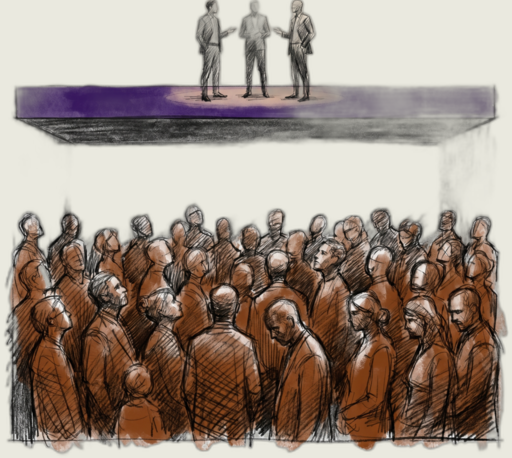
Our offices should encourage casual, cafe-style interactions, but allow people to disappear into personalized, private spaces when they want to be alone. Our schools should teach children to work with others, but also to work on their own for sustained periods of time. And we must recognize that introverts like Steve Wozniak need extra quiet and privacy to do their best work.
Before Mr. Wozniak started Apple, he designed calculators at Hewlett-Packard, a job he loved partly because HP made it easy to chat with his colleagues. Every day at 10 a.m. and 2 p.m., management wheeled in doughnuts and coffee, and people could socialize and swap ideas. What distinguished these interactions was how low-key they were. For Mr. Wozniak, collaboration meant the ability to share a doughnut and a brainwave with his laid-back, poorly dressed colleagues — who minded not a whit when he disappeared into his cubicle to get the real work done.
Fascinating.
Mandatory States
By Daniel Miessler on January 11th, 2012: Tagged as Productivity

I’ve been thinking recently about what states of being are required for optimum health. A few things bring this on: 1) Paul Graham’s writing on how he manages inputs and controls distractions has always penetrated deeply for me, and 2) when I find myself without options for inputs I fiercely enjoy the resulting silence and thought.
To say it plainly, I think I should build silent time, or disconnected time (possibly in isolation) into my day, or perhaps my week. And that’s just one of the types of time I’ve identified. Here they are together:
- Silent Time: time to be without inputs, disconnected from the Internet. Alone with unfocused thoughts and perhaps analog writing implements.
- Fiction Reading: time to relax mental stress and travel off and have experiences.
- Knowledge Reading: time to learn new things and take notes for my concept consumption project.
- Programming: spend time implementing ideas through code. Combines the joy of creation with the cognitive exercise of problem solving and expression of concept through language.
- Exercise: get at least 30 minutes of cardio exercise every other day (low bar) combined with a set of push-ups and sit-ups (to exhaustion) daily. Add in more serious exercise as supplements to this.
- Personal: spend time enjoying friends and my girl. This isn’t about enjoying activities with them, it’s about enjoying them while doing those activities.
So that’s the basic list (to be improved). The silent time is crucial. I find that when I have it I cherish it, but that I never seek it out. Instead I try to cram every moment with some sort of knowledge acquisition or entertainment. This is similar to not sleeping; it’s like not giving the subconscious time to consume and process what we do.
As for the list as a whole, the idea is that if I’m not getting proper dosages of all of these various states then it will cause an elusive but mounting discontent that will resist direct identification. It will essentially be a failure to fully implement some part of myself that is incapable of asking for attention itself.
What are your thoughts on these phases? Do you think they’re all mandatory? Have I missed any?
Notes
1 Other than these there is diet, which isn’t a state obviously but is easily as important. 2 I also need to figure out the right schedule to do these things on.
Small teams beat large teams in software development | Atomic Spin
By Daniel Miessler on January 11th, 2012: Tagged as Productivity
A study done by consultancy QSM in 2005 seems to indicate that smaller teams are more efficient than larger teams. Not just a little more efficient, but dramatically more efficient. QSM maintains a database of 4000+ projects. For this study they looked at 564 information systems projects done since 2002. (The author of the study claims their data for real-time embedded systems projects showed similar results.) They divided the data into “small” teams (less than 5 people) and “large” teams (greater than 20 people).
To complete projects of 100,000 equivalent source lines of code (a measure of the size of the project) they found the large teams took 8.92 months, and the small teams took 9.12 months. In other words, the large teams just barely (by a week or so) beat the small teams in finishing the project!
Given that the large teams averaged 32 people and the small teams averaged 4 people, the cost of completing the project a week sooner with the large team is extraordinary: at $10,000 per person-month (fully loaded employee cost), the large teams would have spent $1.8M while the small teams only spent $245k. I can’t think of too many situations where gaining one week in the schedule could possibly justify this cost differential.
Worth additional study.
A Potential Issue With Immersive Fantasy Games
By Daniel Miessler on December 4th, 2011: Tagged as Gaming | Productivity

I’ve been a role-player since junior high school, and I have been a reader of non-fiction long before that. I have a group of friends from junior high that still game (role-playing), and I noticed over the last couple of years that there was something very negative about it for me. I haven’t been able to capture it until just now.
Basically, it seems possible to become very depressed while doing a certain type of immersive gaming, such as role-playing or World of Warcraft, etc. I have seen it in others and on one occasion a couple of years ago it happened to me for approximately two days. It had nothing to do with events in the game and everything to do with the game being immersive in a certain way.
I realized today that the reason immersive games can be depressing for me is because they split my goal and success-building resources into two worlds — on one side I’m trying to create a vast body of literature and science knowledge and capture it here on my website in well-articulated arguments and essays, and on the other side I’m trying to achieve a number of complex goals within whatever game I’m playing.
And the games can be phenomenally awesome. They are every bit as intricate and nuanced as reality, but with more elements in play because it’s fantasy and has fewer boundaries. So there are relationships, politics, striving to become more powerful, etc. These things take time to plan and contemplate, and once you start working towards goals in that world and expending effort to do so, a switch seems to click in the brain. It’s like it re-prioritizes that world as the primary context for achievement. So after spending a few days or weeks (a number of multi-hour sessions on weekends usually) in a particularly good game, it becomes extremely unpleasant to think about becoming successful in the real world.
My guess is that the brain must have difficulty building resources, power, and respect in two completely different contexts at the same time. So when you’re gaming deeply, that is the reality that your brain cares about becoming significant in, and any other “reality” is an affront to it.
I’ve noticed this behavior in my gaming friends repeatedly over the years, but could not articulate the phenomenon until just now. Every conversation they wanted to have was about gaming (with some exceptions such as movies, cuisine, comics, books, history, etc.), but almost forbidden was any conversation about how to improve our real lives, i.e. getting more education, getting a better job, getting more organized, or working on non-game projects. Everything was about the game we were playing, and it was considered basically rude to talk about growing outside of that context.
The reason for this seems to be explained by this model: their value system existed within the game context, so talking about things outside of the game world was disjointing to them. Perhaps my problem all along has been not realizing how single-focused the brain wants to be; trying to maintain two completely separate value systems just doesn’t work.
Don’t misunderstand: this isn’t simply two different activities we’re talking about. Lots of people have a work life and a play life. Boating, golf, camping, hunting, etc.; most successful people have hobbies that they work to get good at. These aren’t the same because they exist in the real world and have significant crossover with their general advancement efforts. You can talk to a potential mate or a potential boss about your passion for mountain climbing much easier than you can about how well you’re doing in a role-playing game or in a WoW guild.
But what about reading non-fiction? Isn’t that fantasy as well? Isn’t that competing with reality? It’s actually not the same. This is where my revelation yields fruit: the conflict comes in building within an alternative context, not simply consuming within it. So, reading Game of Thrones and Hunger Games and Harry Potter doesn’t produce discord in one nearly as much as immersive gaming because in gaming you’re spending creative energy to become powerful within a context.
That’s the key — the effort to accomplish goals, achieve status, and become successful. This model says that once you start trying to do that within an alternative setting it produces major discord in the brain to try to do it within reality as well. It’s as if humans can only maintain one major context at a time for their personal goals and success ecosystem, and the brain will do what it can to isolate other such models when they present themselves.
So what’s the actionable takeaway from this if you’re experiencing the same effect as I was? Simple: decide which context is more important to you and embrace it. Don’t try to maintain two at a time, and frequently revisit which is the right one for you during a given period, e.g. every six months.
I won’t be giving up gaming myself, but I’ll treat it differently. While I’m pushing towards real-world goals I will play short-term games that don’t require long-term goal-seeking. And when I decide to go hardcore into a game for a few months I’ll back off my pursuit of my real-world efforts. Basically, I’ll be careful to stay in one or the other.
[ 2011-12-05 : I've modified some of the language here as some commenters have said it sounded too much like the result of research as opposed to anecdote, which I thought it clearly was. ]
::
Notes
1 This is why WoW players drop out of the real world while they’re fully immersed. When building a character, gearing up, and participating in a guild to achieve goals, all other priorities fade — including real life. It’s the same for any highly-immersive fantasy setting where there is a goal and achievement framework that does not cross over into the real world.
A Reminder That You’re Not Living
By Daniel Miessler on November 22nd, 2011: Tagged as Life | Productivity
Traveling for 10 months around the world through 17 countries covering Africa, South East Asia, Australasia and North, Central and South America. The trip was centered around surfing and photography
Presenting in Hong Kong, Japan, the US and London
Writing a book for O’Reilly as I went, titled JavaScript Web Applications
Writing another book on CoffeeScript, soon to be published by O’Reilly.
Doing a ton of open source libraries, such as Spine, Spine.Mobile, GFX, and Juggernaut.
Building a startup prototype
Presenting at FOWA
And finally, landing a job at Twitter
A friendly reminder, you understand.
How to Lose Time and Money | Paul Graham
By Daniel Miessler on November 15th, 2011: Tagged as Productivity
A few days ago I realized something surprising: the situation with time is much the same as with money. The most dangerous way to lose time is not to spend it having fun, but to spend it doing fake work. When you spend time having fun, you know you’re being self-indulgent. Alarms start to go off fairly quickly. If I woke up one morning and sat down on the sofa and watched TV all day, I’d feel like something was terribly wrong. Just thinking about it makes me wince. I’d start to feel uncomfortable after sitting on a sofa watching TV for 2 hours, let alone a whole day.And yet I’ve definitely had days when I might as well have sat in front of a TV all day—days at the end of which, if I asked myself what I got done that day, the answer would have been: basically, nothing. I feel bad after these days too, but nothing like as bad as I’d feel if I spent the whole day on the sofa watching TV. If I spent a whole day watching TV I’d feel like I was descending into perdition. But the same alarms don’t go off on the days when I get nothing done, because I’m doing stuff that seems, superficially, like real work. Dealing with email, for example. You do it sitting at a desk. It’s not fun. So it must be work.
Brilliant as always.
If You’re Busy, You’re Doing Something Wrong: The Surprisingly Relaxed Lives of Elite Achievers
By Daniel Miessler on November 12th, 2011: Tagged as Productivity
To summarize these results:
- The average players are working just as many hours as the elite players (around 50 hours a week spent on music),
- but they’re not dedicating these hours to the right type of work (spending almost 3 times less hours than the elites on crucial deliberate practice),
- and furthermore, they spread this work haphazardly throughout the day. So even though they’re not doing more work than the elite players, they end up sleeping less and feeling more stressed. Not to mention that they remain worse at the violin.
I’ve seen this same phenomenon time and again in my study of high achievers. It came up so often in my study of top students, for example, that I even coined a name for it: the paradox of the relaxed Rhodes Scholar.
This study sheds some light on this paradox. It provides empirical evidence that there’s a difference between hard work and hard to do work:
- Hard work is deliberate practice. It’s not fun while you’re doing it, but you don’t have to do too much of it in any one day (the elite players spent, on average, 3.5 hours per day engaged in deliberate practice, broken into two sessions). It also provides you measurable progress in a skill, which generates a strong sense of contentment and motivation. Therefore, although hard work is hard, it’s not draining and it can fit nicely into a relaxed and enjoyable day.
- Hard to do work, by contrast, is draining. It has you running around all day in a state of false busyness that leaves you, like the average players from the Berlin study, feeling tired and stressed. It also, as we just learned, has very little to do with real accomplishment.
Brilliant stuff.
Time Spent Not Reading Books is Time Wasted
By Daniel Miessler on November 1st, 2011: Tagged as Productivity
I’m starting to think that most of the time I’m not reading books I’m not spending my time optimally. Naturally, this doesn’t include time spent with friends and such, but rather time that I’m supposedly “gaining information” by other means.
So, reading news, feeds, and pretty much anything else I can find on the Internet is all decent, but it is a highly diluted experience compared to reading books found there.
Build a reading list. Move through it. Constantly.
::
Your Friends Define You
By Daniel Miessler on October 30th, 2011: Tagged as Happiness | Productivity
Bottom line: If the main topic of conversation you have with your friends is not how you can better yourself, you need to get new friends.
This is the most important line, but I suggest you read the whole thing to see how the author got there. I’d say this is perhaps the most important lesson I think should be given to children: you are who your main friends are. ::